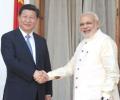
The summit is being seen as an effort by India and China to rebuild trust and improve ties that were hit by the 73-day-long Doklam standoff last year.
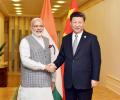
The meeting, which lasted for nearly 50-minutes, comes in the backdrop of stiff Chinese opposition to India's entry into the NSG, which looks after critical issues relating to nuclear sector, including trade and export of nuclear technology.

The meeting with Xi is being held amid the ongoing trade war between the United States and China.

China on Thursday tried to play down the continuing border standoff at Chumar coinciding with the visit of President Xi Jinping to India, saying the incident has been "effectively controlled and managed".

On his arrival, Xi will be welcomed by traditional peformances including 'tappu' folk drum art display at the airport by about 500 artistes.

Earlier in the day, the Chinese embassy in Delhi first posted and later removed a statement on its website saying that the two met after the Congress denied it as "fake news".

Prime Minister Narendra Modi has "strongly" and "clearly" conveyed concerns to Chinese President Xi Jinping over Beijing blocking a proposal for action by the United Nations against Pakistan on the release of jailed Mumbai attack mastermind Zaki-ur-Rehman Lakhvi, with India rejecting the "weak evidence" theory propounded by Beijing in this regard.

Sources said Wang is primarily visiting India to hold boundary talks with National Security Advisor Ajit Doval.

Putin, 62, who holds an 8th dan black belt in Karate, said, "I do not know how to do yoga. When you people do it, it looks difficult. That is why I have not tried it."

Xi will attend the second informal meeting with Modi at Mahabalipuram near Chennai from October 11 to 12 and pay a state visit to Nepal on October 13, Foreign Ministry spokesperson Hua Chunying announced on Wednesday.
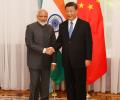
'The fact that Modi and Xi exuded confidence to accelerate the negotiations for a border settlement alone underscores that the Russia-India-China triangle has become very dynamic,' notes Ambassador M K Bhadrakumar.

This will be the fourth visit of Modi to China after he came to power in 2014.

According to some media reports, the Modi-Xi informal summit could take place from October 11-13.

'That the two sides allowed such a situation to arise exposed the level of inaction and inefficiency in China-India border management.' 'The Modi-Xi meeting in Xiamen initiated a process to to avert such contingencies in the future.'

'The Modi-Xi and Modi-Obama meetings, with an interval of just 12 days, are juxtaposed superbly at a crucial point in the prime minister's life. Can Modi carve out a win-win situation with the superpower and the emerging superpower at the same time?'

He said countries should work for promoting open and inclusive cooperation for win-win outcomes.
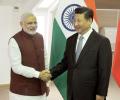
China on Thursday said its stand on blocking India against UN action on Pakistan was based on "facts" and in the spirit of "objectiveness and fairness".

'Problems will keep recurring unless China vows to resolve all outstanding issues between the two sides,' says Sana Hashmi.
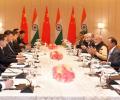
The prime minister started off his remarks at the meeting in Tamil, welcoming China to the talks, which were held right after one-on-one discussions between Modi and Xi at the Taj Fisherman's Cove Hotel.
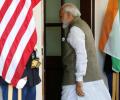
'In the next three decades up to 2050 there will be three important players at the world level.' 'India, US and China will be playing a very important role globally as the largest economies in the world.' 'These three countries will have to interact with each other much more closely because what they do and what they decide will impact the entire world.'

Modi was accorded a grand reception at the Great Hall of People in Beijing on Friday when he arrived for talks with Chinese Premier Li Keqiang.

'Even if such a thing happens, it will not prolong for many days like Doklam did.' 'That is because both the leaders do not want it.'

Modi also said the people of India felt proud that President Xi has twice received him out of the capital.

Xi and Modi are scheduled to hold informal summit talks on Friday evening and on Saturday.
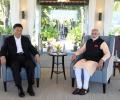
'China physically occupies about 45,000 sq km of J&K as claimed by India, including 3,000 sq km captured in the 1962 War and never returned; and 5,180 sq km ceded to China by Pakistan in 1963.' 'It is hard to justify remaining silent about the return of China occupied Ladakh,' observes Ajay Shukla.

India and China on Monday admitted to intrusion by Chinese herdsmen into Ladakh last week but both the sides sought to play it down saying the issue was resolved amicably through a flag meeting.

Despite drawing a blank in Tamil Nadu, its leaders in the state claimed they should strike roots without using a crutch at this "most opportune" time, reports Radhika Ramaseshan.

Important for Chinese President Xi Jinping will be Zhao's discussions on the issues of Tibet and the Dalai Lama and his assessment of the likely results of India's coming national elections, notes former senior RA&W officer and China expert Jayadeva Ranade.

Other countries need not be worried by Trump putting America first, says B S Raghavan. 'That is what the imperative duty is of everyone heading his country's government: To put his own country first, and make it great.' 'That is what Narendra Modi, Xi Jinping, Theresa May, Angela Merkel, Shinzo Abe and all the democratically elected heads of governments, with the interest of their people at heart, are doing.'
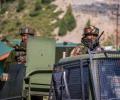
'Why has the peace been kept?' 'Basically because there is a balance.' 'Maybe they think that balance has changed.' 'People can make mistakes. People can miscalculate.' 'If that is the cause, then I think what we have done, matching their build-up, etc, it is giving a good account of ourselves in the face-offs.'

There are still a few lingering issues towards the progress of India-China bilateral relations, the approach for dealing with each other seems to be quite different. With Modi-Xi bonhomie strengthening, it seems that India and China are ready to recalibrate their approaches towards each other, says Sana Hashmi.
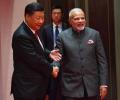
'We must compartmentalise issues, ensuring that one disagreement does not sour everything,' advises Ambassador Kishan S Rana.

'The BRICS anthem has to necessarily be an anthem of Vedic times -- Walk together, Dream together, Achieve together.' 'And who knows it better than Modi?' says Tarun Vijay.
'This novel format of diplomacy -- the informal summit -- will not only facilitate bilateral communication and reduce miscalculations at the very top level of the two governments, but possibly open the space for China and India to speak in one voice on various issues of mutual concern,' note Feng Renjie and Ding Kun Lei

Once again an Indian prime minister has realised that with Pakistan and China, things will not move as he wishes.

Chinese President Xi Jinping's visit to India is a time for the two countries to get away from the haze of rhetoric and stale euphoria, says Sana Hashmi.
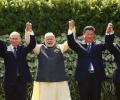
Narendra Modi's success at the BRICS summit is the best Diwali gift for India's diplomacy and marks her ascendancy to global leadership, says Tarun Vijay.

'India should think big: About how in a multi-polar world, India can indeed be one of the poles, rather than being a secondary power that has to worry about 'alignment' with one of the poles. A G3 in other words, India should look to getting others to align with itself rather than the US or China,' says Rajeev Srinivasan.
